I played Brothers – A Tale of Two Sons over the new year and fell in love with it. It’s short and sweet.. maybe around three hours long. The puzzles are not too intimidating, but it was pleasant to see a complete lack of scores, points and kill counts. You basically do what you feel like doing outside of the main story line. The game is lovely to behold, and does take some dark turns as the story progresses.
Minor spoilers in the gallery ahead:
Author: Arun
Vim with Vundle
Full credit to this amazing post: it made my .vimrc so much neater and understandable. Until now I had a mess of plugins pulled from different sources, and I didn’t know which extension was enabling which feature.
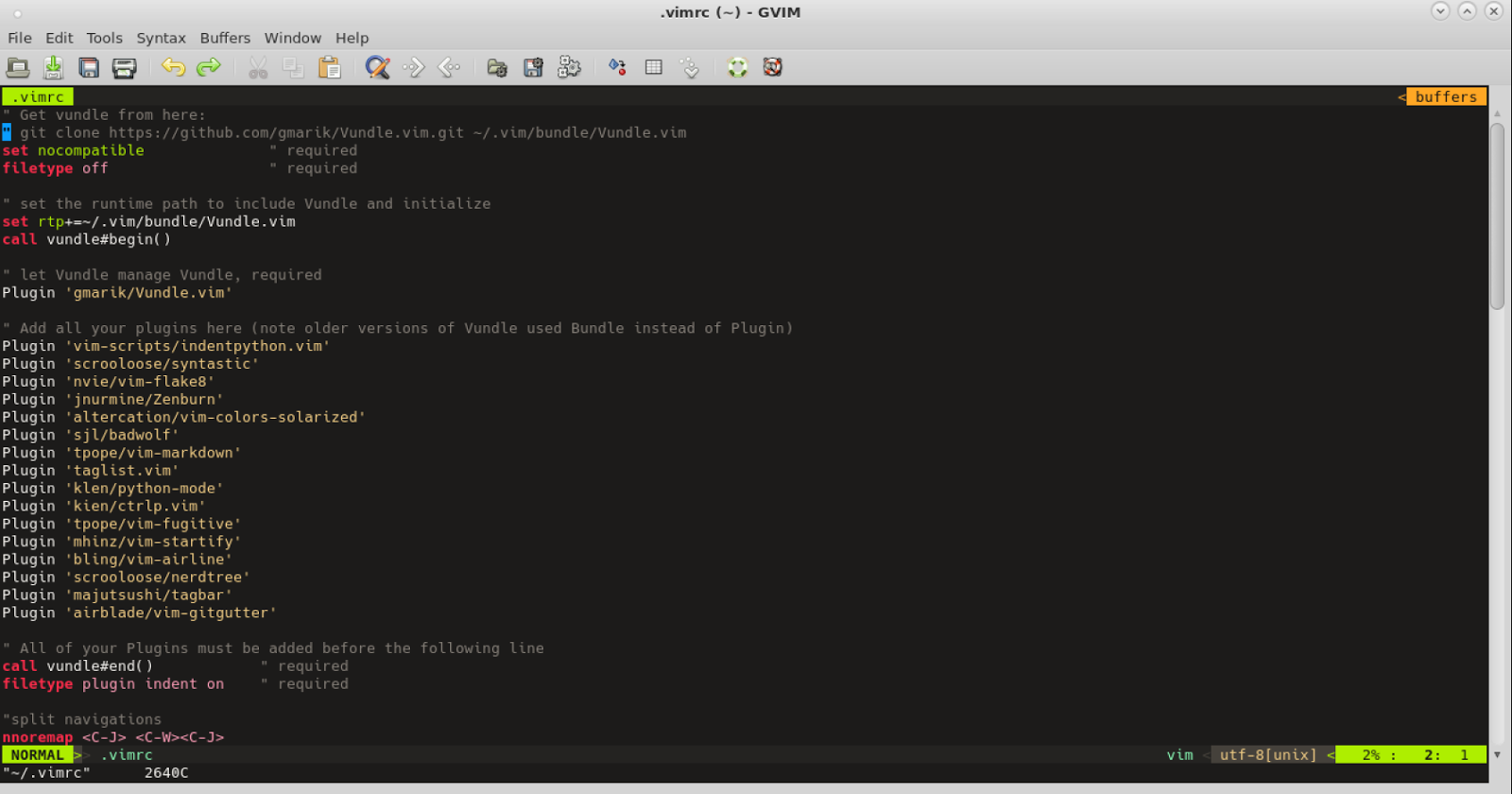
Below is my full .vimrc, mostly identical to the one in the post, with a few minor tweaks that I’m used to. I copied this to a couple of VMs I use, and it is ridiculously simple to clone the Vundle repo and hit :PluginInstall to get everything set up nicely.
" Get vundle from here:
" git clone https://github.com/gmarik/Vundle.vim.git ~/.vim/bundle/Vundle.vim
set nocompatible " required
filetype off " required
" set the runtime path to include Vundle and initialize
set rtp+=~/.vim/bundle/Vundle.vim
call vundle#begin()
" let Vundle manage Vundle, required
Plugin 'gmarik/Vundle.vim'
" Add all your plugins here (note older versions of Vundle used Bundle instead of Plugin)
Plugin 'vim-scripts/indentpython.vim'
Plugin 'scrooloose/syntastic'
Plugin 'nvie/vim-flake8'
Plugin 'jnurmine/Zenburn'
Plugin 'altercation/vim-colors-solarized'
Plugin 'sjl/badwolf'
Plugin 'tpope/vim-markdown'
Plugin 'klen/python-mode'
Plugin 'kien/ctrlp.vim'
Plugin 'tpope/vim-fugitive'
Plugin 'mhinz/vim-startify'
Plugin 'bling/vim-airline'
Plugin 'scrooloose/nerdtree'
Plugin 'majutsushi/tagbar'
Plugin 'airblade/vim-gitgutter'
" All of your Plugins must be added before the following line
call vundle#end() " required
filetype plugin indent on " required
"split navigations
nnoremap
nnoremap
nnoremap
nnoremap
" tagbar at F8
nmap :TagbarToggle
" my favourite font
set guifont=Hack:h11:cANSI
" markdown mode for .page files
autocmd BufNewFile,BufReadPost *.md set filetype=markdown
autocmd BufNewFile,BufReadPost *.page set filetype=markdown
set nofoldenable " disable folding
" python settings
au BufRead,BufNewFile *.py,*.pyw set tabstop=4
au BufRead,BufNewFile *.py,*.pyw set softtabstop=4
au BufRead,BufNewFile *.py,*.pyw set shiftwidth=4
au BufRead,BufNewFile *.py,*.pyw set textwidth=79
au BufRead,BufNewFile *.py,*.pyw set expandtab
au BufRead,BufNewFile *.py,*.pyw set autoindent
" au BufRead,BufNewFile *.py,*.pyw match BadWhitespace /^\t\+/
" au BufRead,BufNewFile *.py,*.pyw match BadWhitespace /\s\+$/
au BufNewFile *.py,*.pyw set fileformat=unix
au BufRead,BufNewFile *.py,*.pyw let b:comment_leader = '#'
" General settings
set tabstop=4 " number of visual spaces per TAB
set softtabstop=4 " number of spaces in tab when editing
set expandtab " tabs are spaces
set wildignore=*.o,*~,*.pyc
set encoding=utf-8
let python_highlight_all=1
syntax on
colorscheme badwolf
let NERDTreeIgnore=['\.pyc
, '\~
] "ignore files in NERDTree
set ignorecase
set paste
set nohlsearch
set incsearch
nmap a=strftime("%A %Y%m%d")
imap =strftime("%A %Y%m%d")
:set pastetoggle=
set laststatus=2 "airline needs this
let g:airline#extensions#tabline#enabled = 1
let g:ctrlp_custom_ignore = '\v[\/]\.(git|hg|svn|pyc)

Install new fonts on Linux
I wanted to install Hack recently, and this is how I did it:
Make a folder and dump the .ttf files there:
mkdir -p /usr/share/fonts/hack
Then run this:
fc-cache -f -v
Change timezone in Linux
Here’s a quick tip that I’ll need to keep getting back to every now and then.
In Centos:
ln -s /usr/share/zoneinfo/Asia/Kolkata /etc/localtime
In Debian:
timedatectl set-timezone Asia/Kolkata
Writing service files in systemd
Systemd may not be the most popular init system out there, and it still manages to annoy me every now and then, but I had a chance to play with it at work recently. A deeper dive into it has left me a little happier with how it handles things.
My requirement was to daemonize a service and have it running at startup. The service has a few command line arguments, and also needs some environment variables set. The command line args could change but should not expect someone to reconfigure the init script. Systemd supported all these requirements out of the box.
Here is what the service file looked like:
[Unit]
Description=myservice
[Service]
Environment="LD_LIBRARY_PATH=/usr/local/lib:$LD_LIBRARY_PATH"
EnvironmentFile=/etc/
ExecStart=/usr/bin/myservice ${arg1} ${arg2} ${arg3}
[Install]
WantedBy=multi-user.target
The EnvironmentFile has name value pairs of the command line arguments:
arg1=foo
arg2=bar
arg3=baz
There are numerous others configuration parameters for the service. For instance, set Type=oneshot if the application is not a daemon and is going to exit immediately.
Use ExecStartPost for running additional scripts after the first one starts (e.g. maybe you want to write to a pidfile). ExecStartPre, ExecStopPost and ExecStopPre also exist.
The unti file must be present in /etc/systemd/system. To make it run on subsequent boots:
systemctl enable myservice
To start the service:
systemctl start myservice
To check the service’s logs:
journalctl -u myservice
Further reading:
Writing service files in systemd

Systemd may not be the most popular init system out there, and it still manages to annoy me every now and then, but I had a chance to play with it at work recently. A deeper dive into it has left me a little happier with how it handles things.
My requirement was to daemonize a service and have it running at startup. The service has a few command line arguments, and also needs some environment variables set. The command line args could change but should not expect someone to reconfigure the init script. Systemd supported all these requirements out of the box.
Here is what the service file looked like:
[Unit]
Description=myservice
[Service]
Environment="LD_LIBRARY_PATH=/usr/local/lib:$LD_LIBRARY_PATH"
EnvironmentFile=/etc/<somefile.cfg>
ExecStart=/usr/bin/myservice ${arg1} ${arg2} ${arg3}
[Install]
WantedBy=multi-user.target
The EnvironmentFile has name value pairs of the command line arguments:
arg1=foo arg2=bar arg3=baz
There are numerous others configuration parameters for the service. For instance, set Type=oneshot if the application is not a daemon and is going to exit immediately.
Use ExecStartPost for running additional scripts after the first one starts (e.g. maybe you want to write to a pidfile). ExecStartPre, ExecStopPost and ExecStopPre also exist.
The unti file must be present in /etc/systemd/system. To make it run on subsequent boots:
systemctl enable myservice
To start the service:
systemctl start myservice
To check the service’s logs:
journalctl -u myservice
Further reading: