
Outside
It’s hard for a book lover to convince a non-reader to pick up the habit. You nag and rave and persuade them and they finally probably accept out of politeness. So you lend them a favourite and wait an impatient week and ask them how it went, and you get the familiar list of dreaded responses.
Worse, with those annoying little phones constantly buzzing around us, there’s a steady drip of mindless dopamine hit after hit. The apps on these phones are backed by billion dollar companies that are hugely invested in manipulating you to use their app every moment of the day. Over time, your brain rewires itself to respond to that Pavlovian buzz. Unlock, swipe, like, and repeat.
After years of this brainwashing, how can you expect someone to pick a 400-page book and read it with concentration for more than fifteen minutes at a time? We have enough ‘light’ entertainment to suck our time away.
How, then, to convince some one of the value of deep reading? This article makes a good attempt. Yes it’s long. That’s partially the point. Complex ideas cannot be expressed in tweet-sized chunks. Reading deeply creates a richer self by letting one think through and form one’s own understanding.
In any case, convincing others may be futile. I see a value in reducing social media distractions and committing to deep reading sessions, so I shape my habits accordingly.
I saw the following neat little trick in this link:
# renaming a long file-name using a regex
$ touch config.txt
$ mv config.txt !#:1:s/txt/json
The exact meaning of the !# is, quoting from the man page:
Event Designators An event designator is a reference to a command line entry in the history list. Unless the reference is absolute, events are relative to the current position in the history list.
! Start a history substitution, except when followed by a blank, newline, carriage return, = or ( (when the extglob shell option is enabled using the shopt builtin).<snipped>
!# The entire command line typed so far.
From ‘man bash’
i.e. most people know that bash can insert things from history using commands like !! and !50 (i.e. rerun last command and rerun the 50th history item respectively).
But !# let’s you take something from the existing line and re-use it.
Here is another example, from here:
curl http://beyondgrep.com/ack-2.14-single-file > ~/bin/ack && chmod 0755 !#:3 In this case, !#:3 takes the 3rd element from the existing command. Starting from zero, that turns out to be ~/bin/ack in this case.
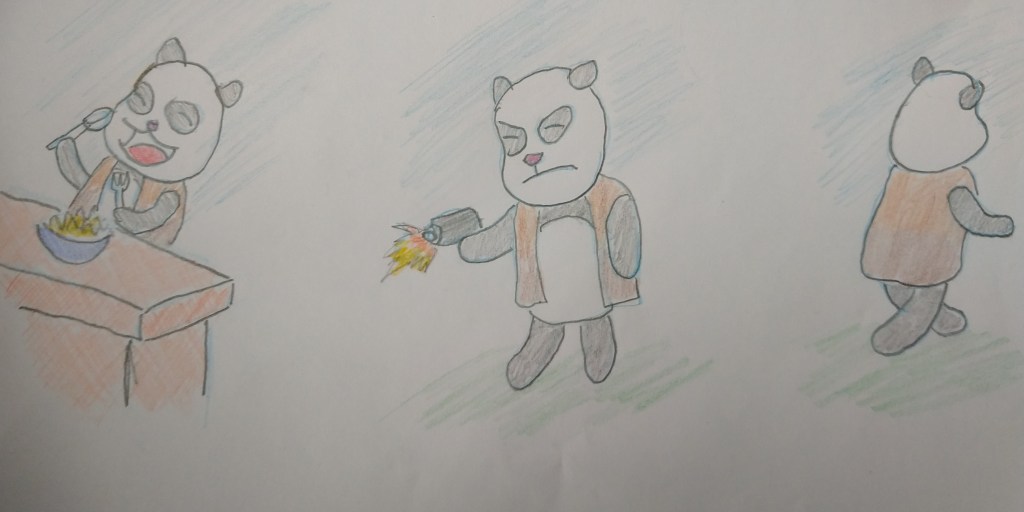
This one is for the pedants. Read this book if you’re the kind of person who grits your teeth every time you see a grammatical mistake in a hoarding. The title refers to a statement about a panda that eats (bamboo) shoots and leaves. But a misplaced comma makes it sound like a story about an evil panda that eats, shoots and leaves.
We are like the little boy in The Sixth Sense who can see dead people, except that we can see dead punctuation.
Lynne Truss
Starting with the oft-misplaces apostrophe to the lesser used dashes and colons, each chapter deals with the history, usage and evolution of a punctuation mark. What I found most fascinating was the origin story of each of these little marks.
The author is not one of those crufty old people who insists that their crufty rules are the only ones that are worth following. Nor does she favour the semi-literate lower-case-ridden style of the smart phone generation, of course. What still matters is to adhere to some semblance of rules.
As a self-deprecating, fun rant, this was an enjoyable read.
In our tiny corner of the Universe, we know (to the best of our limited knowledge) that we’re the only intelligent species that exists. But space is vast and we can still send a message across even if we don’t deliver it personally. What message should we send, and how?
First, let’s talk about language. Our language has evolved over centuries in different civilizations. Some languages have symbols like A-Z to represent their alphabet, while others like Chinese use pictures. I think it is fair to say that an alien would understand neither. What language would be a common ground between humans and aliens? The answer is Mathematics. Even if an alien did not use a decimal system, we have good reason to believe that the laws of mathematics are truly universal. The value of pi remains the same in decimal or binary or whatever representation an alien would choose to use. As a means of communication, an alien would certainly be interested that we as a species were aware of Newton’s laws, Einstein’s theories of relativity, and so on.
Next, consider the form. Sending a signal through radio waves sounds reasonable at first, but these get considerably weaker as they travel. Sending a physical device is another approach, but it is impossible to target it when you don’t know the destination. The probability of aliens locating, accessing and decoding a tiny probe in the vastness of space is tiny indeed. But we are nothing if not ambitious. The Voyager space probes are doing exactly this. We have carved messages in Gold records and shipped them in these spacecrafts. (The records are made of Gold because it is a noble metal and is very resistant to corrosion, so we expect this message to last for centuries if not more.)
Finally, consider the content. What could we conceivable talk about that would impress an alien civilization? Lewis Thomas considered this in his book “The Lives of a Cell”. For him the answer was obvious. “Send Bach. All of Bach”, he said. A more detailed answer was given by a team led by Carl Sagan that constructed the contents of the Voyager records. They took a wide rather than deep approach. Some of the sounds include those of Whales, laughter, wind, rain, vehicles and so on. We feel music is a universal language, so there is a lot of music from a variety of cultures the world over. There are images of humans, the earth’s place in the solar system, and so on. And most importantly, there is a pictorial representation of how to decode and play back the images and audio.
Attempts like these are ultimately hopeful rather than practical. They provide an opportunity to see and represent humanity’s best side in a message that will outlive us all. For non-experts like us, they provide fertile ground for thinking about how to communicate across cultures and finding common ground.

