Notes on the book "Flow"

Title: Flow
Author: Mihaly Csikszentmihalyi

I’ve long been interested in Active vs Passive hobbies, why one is better than the others, and so on. Here’s a nice reddit post that captures a similar mindset around gaming. So reading Flow gave a lot of clarity to these ideas.

Any programmer who’s been ‘in the zone’ and loses sense of time knows the feeling of ‘Flow’ and that is the subject of this book — Deep hobbies that improve one’s self.

The author categorizes activities with good ‘flow’ if they meet these criteria:

  • A challenging activity that requires skills
  • Requires concentration
  • Has clear goals and immediate feedback
  • Removes awareness of everyday frustrations
  • Exercises control over ones own actions
  • Concern for self disappears
  • Sense of time altered

Here are some sections from the book that caught my attention:

“The wisdom of the mystics, of the Sufi, of the great yogis, or of the Zen masters might have been excellent in their own time — and might still be the best, if we lived in those times and in those cultures. But when transplanted to contemporary California those systems lose quite a bit of their original power. They contain elements that are specific to their original contexts, and when these accidental components are not distinguished from what is essential, the path to freedom gets overgrown by brambles of meaningless mumbo-jumbo. Ritual form wins over substance, and the seeker is back where he started.”

“Pleasure is an important component of the quality of life, but by itself it does not bring happiness. Sleep, rest, food, and sex provide restorative homeostatic experiences that return consciousness to order after the needs of the body intrude and cause psychic entropy to occur. But they do not produce psychological growth. They do not add complexity to the self. Pleasure helps to maintain order, but by itself cannot create new order in consciousness.”

“In today’s world we have come to neglect the habit of writing because so many other media of communication have taken its place. Telephones and tape recorders, computers and fax machines are more efficient in conveying news. If the only point of writing were to transmit information, then it would deserve to become obsolete. But the point of writing is to create information, not simply to pass it along.”

The middle quote is a satisfactory answer to my question on what differentiates mindless passive hobbies from effort-intensive active ones: the latter create better versions of ourselves.

“Good Math” Notes

Full Title: Good Math: A Geek’s Guide to the Beauty of Numbers, Logic, and Computation

Author: Mark C. Chu-Carroll

Here are some notes I took while reading this book. Overall I felt it was interesting, but there were large jumps in difficulty in some of the later chapters.

Continuous fractions

This was the most fascinating part of the book for me. I hadn’t heard of these before!

For example, the square root of 2 in decimal form is approximately 1.4142135623730951. But if you represent it as a continued fraction, you get [1; 2, 2, 2, 2, 2, …]. All of the square roots of integers that are nonperfect squares have repeated forms in continued fractions.

Interesting how continuous fractions give a new and clean way of looking at previously confusing numbers like sqrt 2 and other irrational numbers. Some nice parallels with how multiplication was hard in the Roman numeral system but drastically improved in tha arabic system.

Another great example is e. If you render e as a continued fraction, you get e = [2; 1, 2, 1, 1, 4, 1, 1, 6, 1, 1, 8, 1, 1, 10, 1, 1, 12, 1, …]. In this and many other cases, continued fractions reveal the underlying structure of the numbers.

First Order Predicate Logic

This chapter was not easy. But the section on prolog looked neat. Every statement is essentially a proof that the language satisfies. Now we’re into CTL i.e computational tree logic maybe?

FOPL has no notion of time, so it’s not easy to make logical statements and assertions with it when there is a time context e.g employee (me, Cisco, 2020) is cumbersome.

FOPL is interesting because it allows us to reason with statements and prove things without knowing a thing about the actual context. The proofs come purely through logic.

Set theory plus FOPL form the foundations of maths.

FOPL summary

In first-order predicate logic, we talk about two kinds of things: predicates and objects. Objects are the things that we can reason about using the logic; predicates are the things that we use to reason about objects.

A predicate is a statement that says something about some object or objects. We’ll write predicates as either uppercase letters or as words starting with an uppercase letter (A,B,Married), and we’ll write objects in quotes.

Every predicate is followed by a list of comma-separated objects (or variables representing objects). One very important restriction is that predicates are not objects. That’s why this is called first-order predicate logic: you can’t use a predicate to make a statement about another predicate. So you can’t say something like Transitive(GreaterThan): that’s a second-order statement, which isn’t expressible in first-order logic. We can combine logical statements using AND (written ∧) and OR (∨). We can negate a statement by prefixing it with not (written ¬). And we can introduce a variable to a statement using two logical quantifiers: for all possible values , and for at least one value.

Naive set theory

This is what Cantor used for his diagonal trick to measure different sizes of infinities, is limited by things like Russel’s paradox. If you use FOPL to make theories about naive sets, you eventually hit a contradiction that challenges the foundations of logic. In summary It allows you to create logically inconsistent self referential sets. The next chapter has a better alternative: axiomatic set theory.

Axiomatic Set Theory

It uses axioms to give a consistent form of set theory based on some axioms. The one in this book is Zermelo-Frankel set theory with choice, commonly abbreviated as ZFC.

First we define a set by asserting that 2 sets are equal if you pair their objects and those are equal. Ths gives us a mechanism to get and compare elements, and defines a set and it’s main operations.

Once we define an empty set, we automatically get a new one which is the set containing the empty set. Then you define an enumeration axiom that allows you to append 2 sets.

Then the default infinite set is created, out of which other infinite sets are derived. This axiom carefully ensures that these sets are not self referential, thus avoiding paradoxes.

A powerset of A is the set of all possible subsets of A.

Using a powerset axiom, we now provide the ability to take an infinite set and build a second order set that’s larger than it.

Anyway once you have the final ‘axiom of choice’, you have this set theory combined with fopl to create all of maths. Integers come naturally. Axiom of pairing can be used to get the rational numbers. Dedekind cuts can be used to get the reals. And so on.

Todo add a note on what a dedekind cut is. From what I remember, you can define 2 sets, one that has all elements lesser than sqrt(2) and one that has all elements greater. That gives a clear definition for sqrt(2) itself.

Continuum hypothesis

The first infinite set larger than aleph0 (set of natural numbers) has a size equal to aleph0’s powerset (the set of all subsets of aleph0), and this is also the size of all the reals.

Unfortunately it is neither true or false. You can treat it as either and all of zfc maths will still work.

Here we have a hypothesis that is not provable, whereas in Russel’s paradox we had an inconsistency.

Group theory

Last bit went over my head :(

Mechanical math

Haskell code doesn’t help :(

Hate Inc. Review

Full Title: Hate Inc.: Why Today’s Media Makes Us Despise One Another

Author: Matt Taibbi

I’ve been reading Taibbi for a while now and this was a nice refreshing step back from his usual acerbic style. He covers the media industry’s complicity in creating a toxic political environment. Towards the end is where the book gets really interesting: as an inward-looking view into how the left-leaning media is as bad in creating filter bubbles as the usual suspects in the right.

Here are some snippets I saved from the book.

On Facebook’s curation of news

Chomsky: Take a look at the Facebook phenomenon. Where are they getting their news from? They don’t have reports.

They’re just getting it from the New York Times, so it’s the same sources of information. They’re just putting it out in trivialized form, so that people with a ten- year-old mentality can handle it. It’s a very dangerous thing. They’re not doing any of the things that the media do. They don’t frame things. They don’t select. They don’t send reporters out. They don’t investigate, you know, they just collect information and hand it over to kids to look at in ten minutes so you don’t believe the newspapers.

Red flags to look out for

Tricks used by the government to feed news via allied countries:

This is one reason to always have ears up when you start hearing bits and pieces of important intelligence cases happen to have been uncovered within the borders of America’s closest intelligence allies, particularly England, Australia, the other “Five Eyes” nations, and key NATO members.

Regarding unnamed Ferguson sources:

What is the purpose of the anonymity? Is it to protect someone’s job or freedom? Or to insulate the person against political consequence if the story goes sideways?

Who initiates the communication?

Incidentally: it’s a red flag if the call is coming from the official, as opposed to the reporter calling the officials. The average intelligence official wouldn’t stop to tell you if your child was on fire. When they start cold-calling agencies, and/or rotating scoops by doling them out to different outlets and papers each week, that’s a huge red flag.

Journalist histories:

When you see one of these stories, check to see if that reporter has a history of national security pieces. If he or she does not, if this transmission of classified scoops is taking place in the context of a new relationship, be extra wary.

U.S. Wars

In addition to actions in Syria, Afghanistan, Iraq, Somalia, Libya, and Niger, we’d been aiding the Saudi bombing of Yemen for nearly 1,100 consecutive days on December 11, 2017, when the Pentagon submitted its latest “where the hell we’re currently at war” summary—also known as a section 1264 report, which has to be delivered to Congress every six months under the National Defense Authorization Act.

The Art of the Infinite – Review

This is the kind of book I wish I’d read 20 years back.

The Kaplans cover a lot of ground, so the book is densely packed with remarkable insights. Although most of the topics (algebra, geometry) were covered in my school syllabus in my younger days, the difference is in how it bridges vast areas of mathematics together.

A seemingly insurmountable problem is shown first. Then some remarkable piece of magic happens. And the clouds clear and light shines through.

A book like this gives a glimpse of the awe-inspiring structure and symmetry in the Universe that mathematicians create in their minds.

Great books for little kids (and their parents)

I read a couple of stories to my 4 year old daughter every night before she sleeps. Writing a book for a kid is not an easy task. Most take the easy way out and write straightforward stories that try to teach ‘good habits’ to kids: don’t litter, share your toys, be kind and so on. I suppose this sort of book serves a useful purpose and I’ve read several of these to my daughter too.


But there are other truly great ones that are special for both parents and kids. Pixar knows how to make movies like this. I still have fond memories of reading the original Winnie the Pooh books, Lewis Carroll’s Alice books and so on. But my kid isn’t ready for those yet. Here are some targeted at younger audiences that she and I adore:


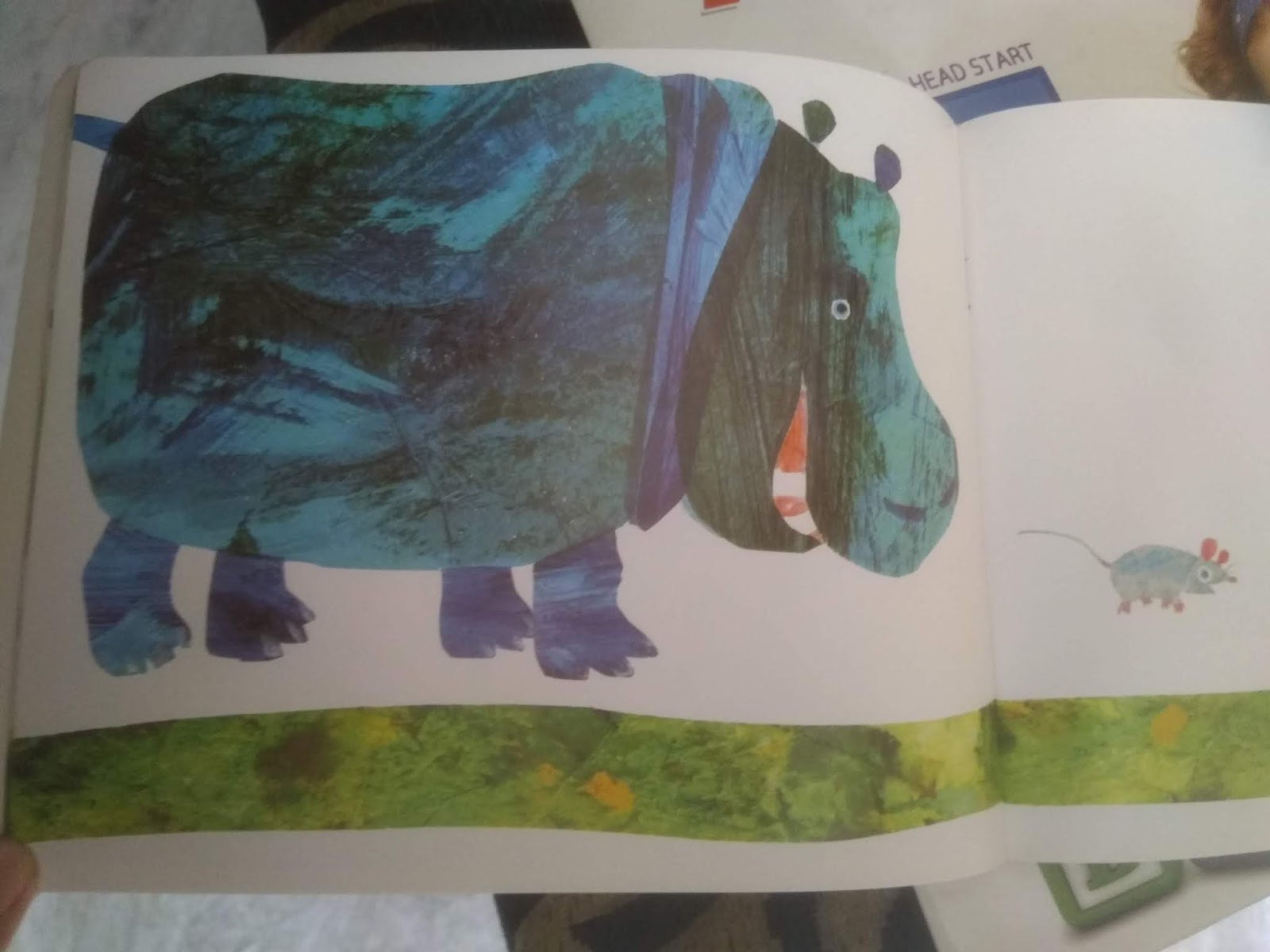
Everything Eric Carle. This should go without saying. He has a knack for teasing the next page and building on a theme throughout the book.

His art style is distinctive and immediately recognizable. This page here is from Do you want to be my friend, but any of his books is guaranteed to be good.

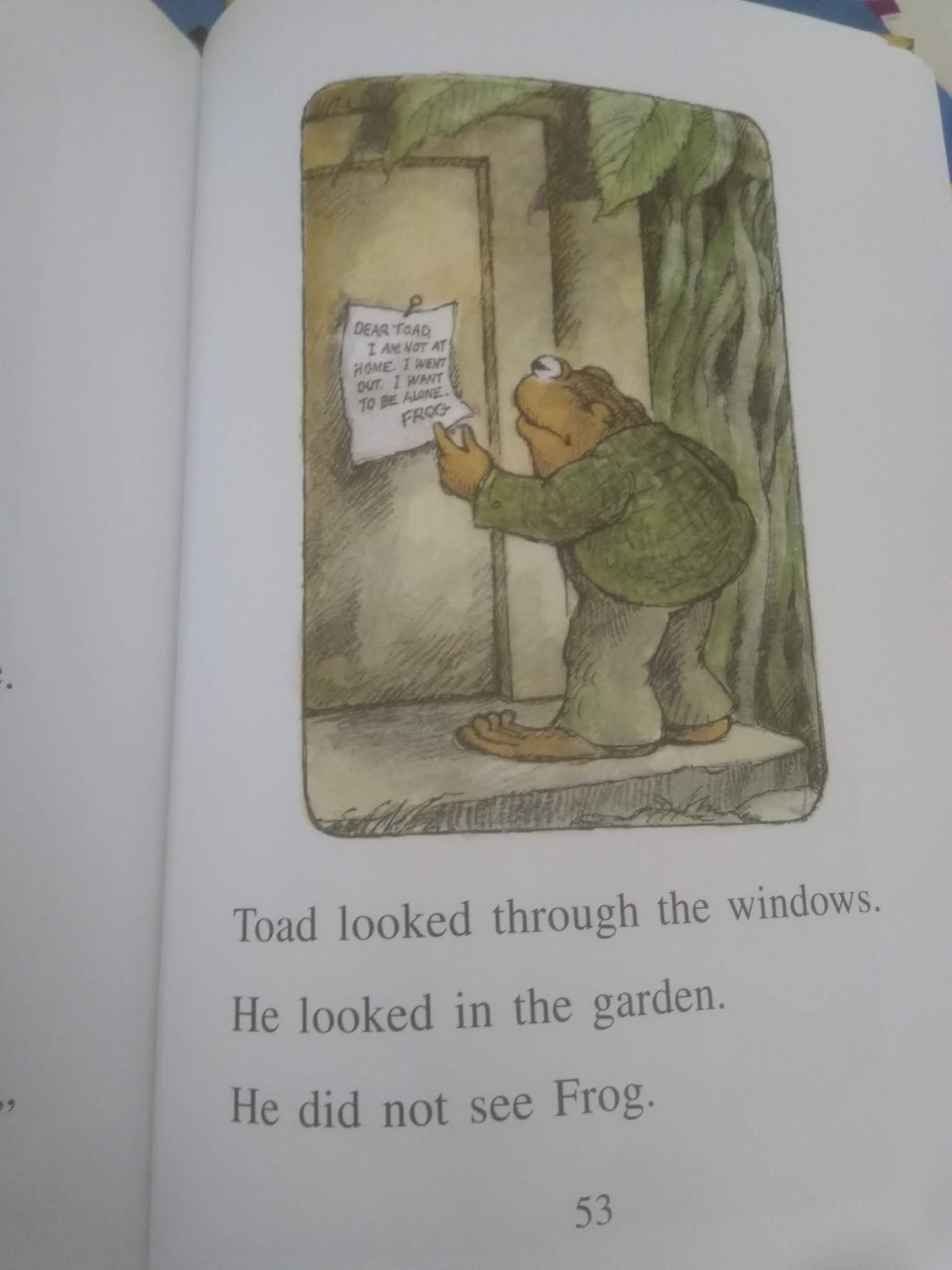
Next up is the Frog and Toad series by Arnold Lobel. They consist of a set of short stories of two adorable friends, a frog and a toad. The themes these books cover go far beyond what you’d expect from a kid’s book.

There are tales of solitude, bravery and temptation. Poor Toad is not always up to these challenges but he tries his best. And sometimes there are some sweet silly stories with no deeper lessons.

These are the books I’m reading most with my daughter nowadays. She has a lot of the plot memorized pretty well and is now making attempts to read some of the words.


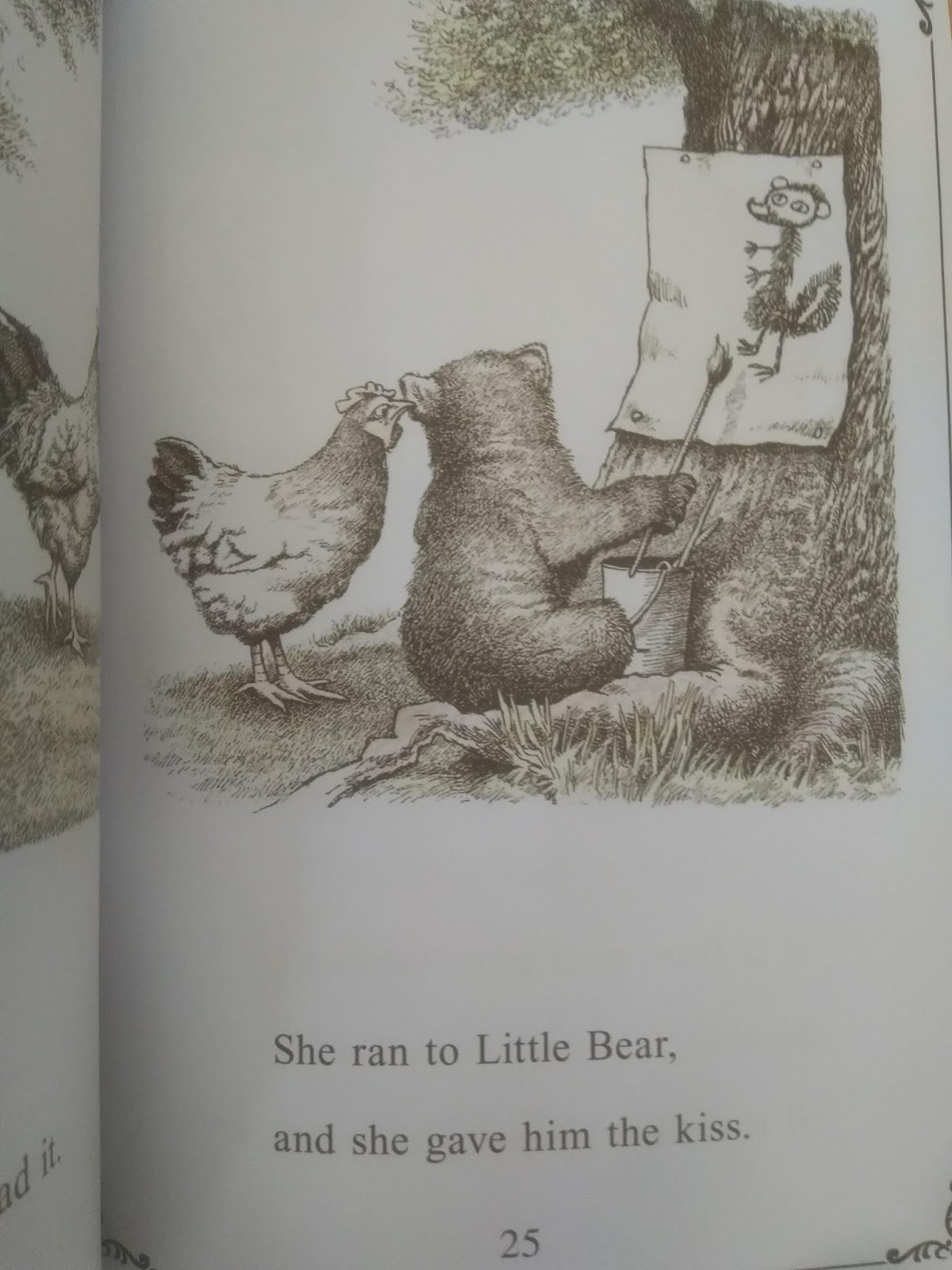
Next up is A kiss for little bear by Else Minarik, with art by Maurice Sendak. I’ll admit I like this a lot more than my daughter does. It’s a short and sweet tale of a kiss passed from Grandma Bear to Little Bear through a series of animals.

The best reason to have this book is to give your little one a peck for every one that happens in the book. And it happens a lot!
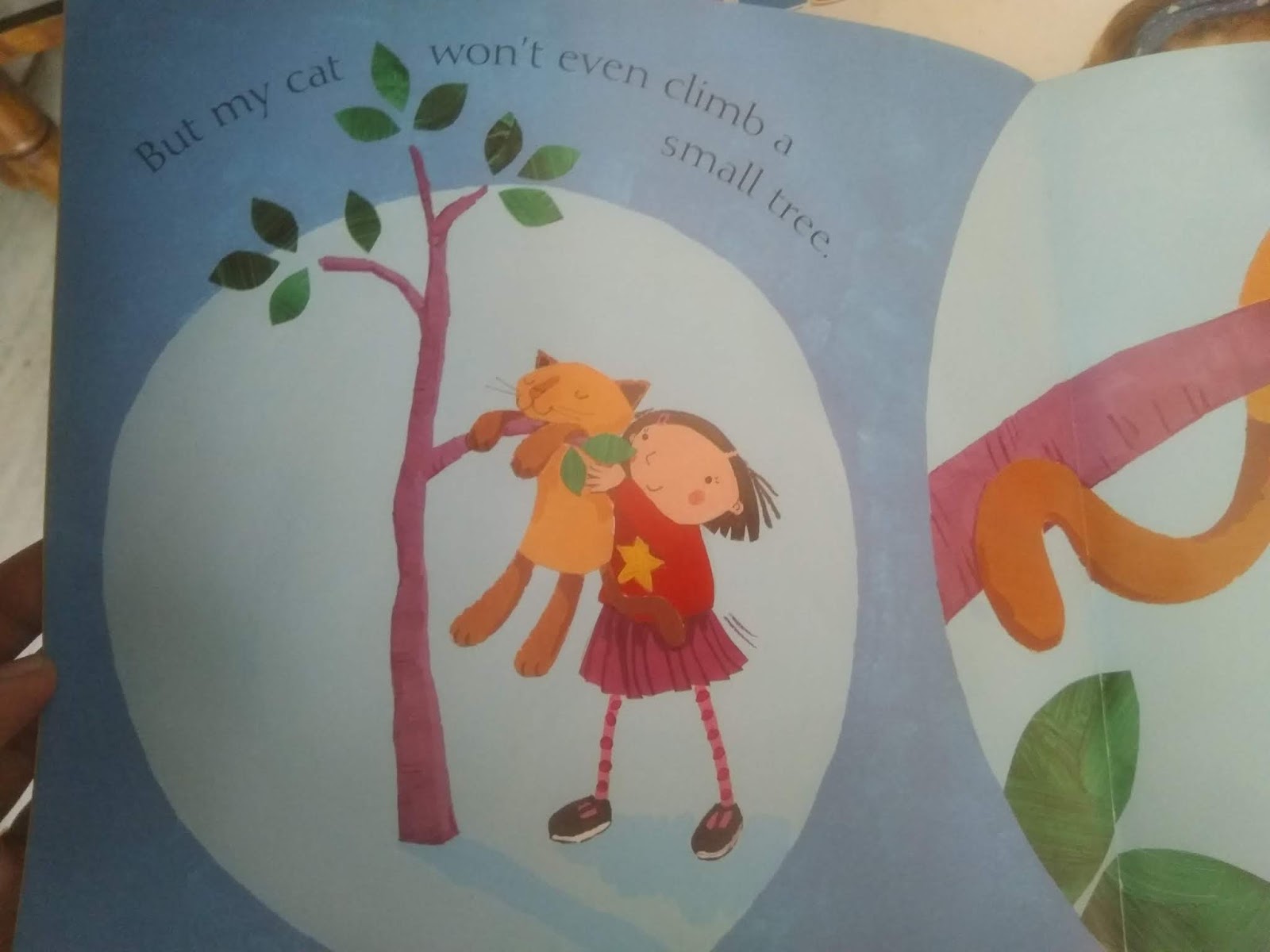
Finally, a random pick at a book shop led to this delightful book about a girl’s lazy cat that just sleeps all day. I love this for the artwork and the cute little twist at the end. This one is called My Cat Just Sleeps and is by Joanna Partis.

Strunk & White today

As someone who suffers from perennial writer’s block, Strunk & White does nothing to help. I spent thrice the usual time thinking up the post title. Could it be terser? Does it convey the primary content of the post? Should it mention the Elements of Style is also adorably funny on occassion?

I hadn’t read the book before but had come across more than enough posts declaring its demise. I’ve read it now and thoroughly enjoyed it. I love when people have strong opinions and its authors have them in abundance. I suppose its detractors forget that the title is ‘The Elements of Style’ and not ‘The-mandatory-guide-to-perfect-English-and-everything-else-is-wrong’. The authors themselves frequently advise rather than mandate, and acknowledge that language is fluid and bound to change with the times. Why nitpick then? We’re all grown ups here–we should learn to enjoy a book while knowing how to separate its outdated advice from the relevant bits.

I love it most for its terseness. It reminds me of reading a man page. Brimming with content, but precise.  Any one who has been through the education system knows the drivel that students are encouraged to vomit in every exam. This ‘skill’ is a pain to unlearn and lives on in mediocre minds in their profession as well.  Read that link and weep.

Better to end with Strunk himself, rather than the atrocious text in that link.

Vigorous writing is concise. A sentence should contain no unnecessary words, a paragraph no unnecessary sentences, for the same reason that a drawing should have no unnecessary lines and a machine no unnecessary parts. This requires not that the writer make all sentences short, or avoid all detail and treat subjects only in outline, but that every word tell.