Books read in July

The Letters of Vincent Van Gogh, by Vincent Van Gogh

My wife got this as a birthday gift. It is a tragic look at Van Gogh’s suffering but passionate and all too brief life. The editor’s notes before each section were quite helpful in setting the context. Before reading this, I saw Loving Vincent, a beautiful tribute to the same author. So I’d recommend folks to watch that movie first, and dive into the week if they crave more.

The Checklist Manifesto, by Atul Gawande

I’m been tweaking my productivity tools, and this seemed like a well-recommended book in that space. It is quite nice although a bit light. The summary is that in high pressure and critical jobs, experts usually look for corner-cases but quite often miss the basics. And a good checklist serves as a reminder for a group of people to coordinate tasks well.

Pomodoro Technique Illustrated, by Staffan Noteberg

Continued my productivity investigation with this book. Again, a light, enjoyable read. I read the book using the Pomo technique itself and quite liked the approach. I have too many meetings at work these days to be able to use this as often as I’d like. But it seems like a nice way to pace your work without getting swamped by distractions.
Books read in June

Thinking, Fast and Slow by Daniel Kahnemann

Did not have high expectations going in, as I was already aware that an entire chapter was essentially worthless due to the replication crisis that has proven that most research around priming has very little value.

I find survey-based research rather depressing. The book time and again states that researchers have a poor understanding of statistics, and the subjects display a high variability in their answers based on trivial and unrelated conditions. But it then goes on to quote study after study as if it were fact.

I’ve enjoyed other areas in non-fiction a lot more than this one and should probably stick to them.

Mistborn: The Final Empre by Brandon Sanderson

My first by the author. Thoroughly enjoyed it. Did not have too many of the usual fantasy tropes about heroes and destiny and so on.

All Systems Red by Martha Wells

Was a short science fiction piece I read for a change of pace. It had a decent cast and atmosphere.

Books read in May

Assassin’s Apprentice by Robin Hobb

I wanted to read a good fantasy book and this was the one I picked. Very enjoyable read and seems worth committing to finish the trilogy.

The Pig That Wants to Be Eaten, by Julian Baggini

Fun armchair philosophy thought experiments. There are a hundred of them, from age old paradoxes (Zeno) to funny insights that trigger a deeper train of thought (Douglas Adams). The fact that there are so many make this book harder to read in one sitting. Good in bite-sized chunks.

Nexus, by Ramez Naam

Wanted a switch from fantasy to science fiction so I tried this one out. It was alright.

Books read in April

The Brain: The Story of You, by David Eagleman

Felt like a short read that didn’t go deep enough but this was a nice introduction to our current undertanding of how the brain functions. The author does a nice job of keep things interesting at a high level.

Golden Gate, by Vikram Seth

This is a technically brilliant book but ultimately dealt with themes outside my usual genres.

Haunted, by Chuck Palahniuk

Ahh this one is not for the queasy. A collection of uncomfortable short stories about cynical wannabe authors stuck in a writers’ retreat.

Books Read in March

Myths and Legends of Ancient Greece and Rome, by E. M. Berens

After reading Stephen Fry’s take on this genre, it was refreshing to read a more classic take. Highly recommended. I was fascinated by this kind of stuff when I was young. Is adulthood mostly us trying to recapture those days?

Despair, by Vladimir Nabokov

I wrote about it here.

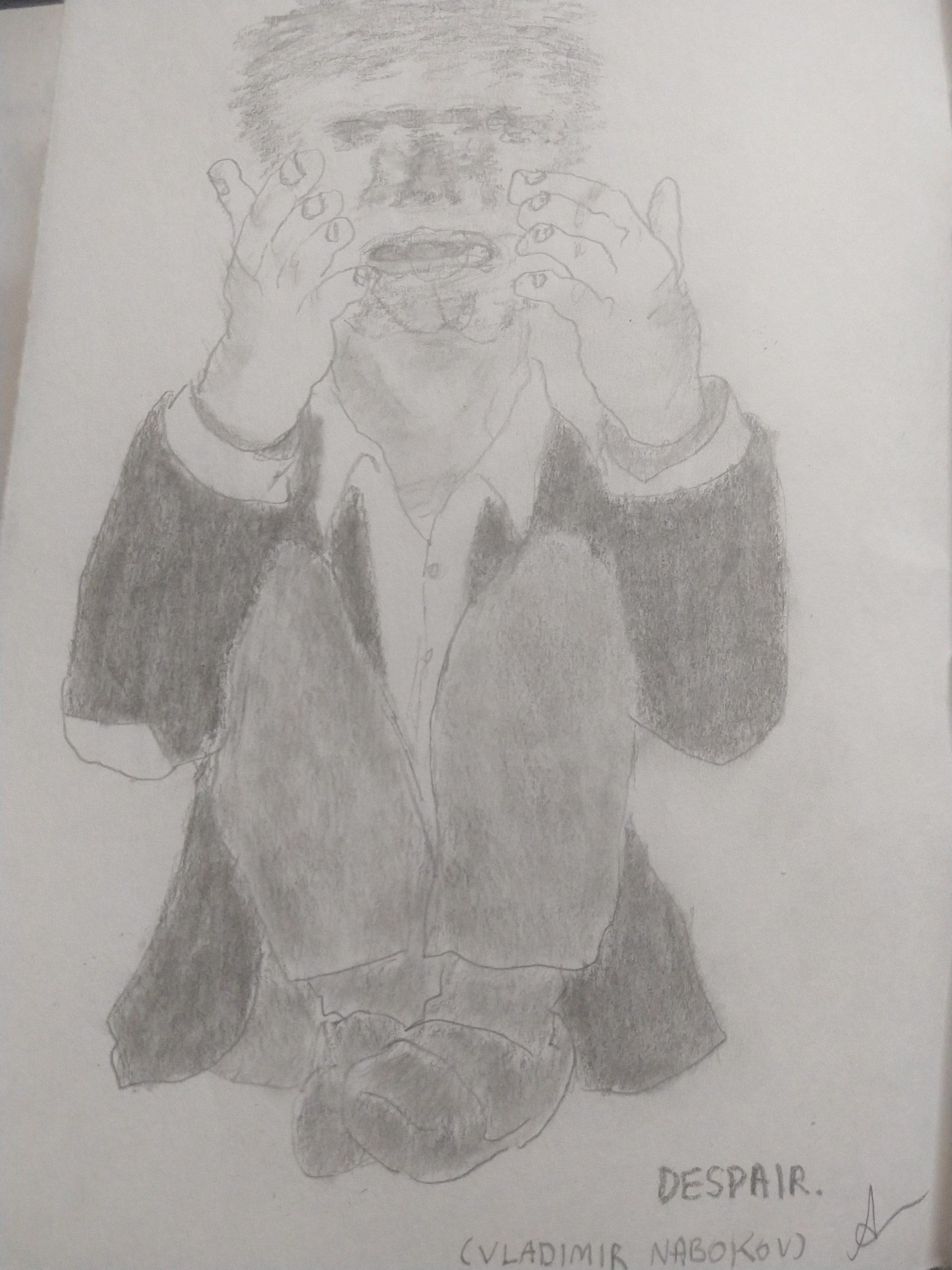
Despair, by Vladimir Nabokov

(Drawing by me)

I reread this book this month. Nabokov’s protagonists are always fascinating. The one is Despair, Hermann, is almost tragic in how desperately he hides from reality. In this he is like that other great unreliable narrator, Charles Kinbote from Pale Fire. And when people in the real world laugh and point a finger at this naked emperor, he chooses to recede into a reality where his garments are the finest, his wit awes his friends, and his intellect outwits the police.

You are never really certain if perhaps, deep down, he knows but continues to pretend. The monster gets his comeuppance and descends into despair. His fine plots are tangled. For all the world he is a bumbling crook but in his mind he is inches away from the perfect crime, bested only by bad luck.

Highly recommended to read and re-read.