
Lightweight galleries with llgal

I’ve been meaning to install a gallery in this site for some time now. I’ve previously used and liked Zephoto. Nothing very new seems to have come up since then, apart from something like Piwigo.

Anyway, since Blosxom is the happiest experience I’ve had with a blogging engine, I was happy to come across an equally elegant solution for web galleries: llgal. This is just a single CLI that most distros ought to come with. Setup is mind numbingly easy, all I had to do was cd to the folder with pictures and type:

llgal —title="n900"

And that got me this gallery. Could anything be simpler? the only other thing I wanted was decent authentication. Well, I have an SSL cert for this site so Basic Auth + SSL could have been enough. Anyway, I decided to try out Digest Authentication this time. Configuration is as easy as it is for Basic. I used the Apache documentation as a reference and didn’t face any problems.

So there it is. A light-weight, clean image gallery in one command. No php/mysql weirdness, no constant upgrades, no hassle.
5 reasons why DuckDuckGo is an awesome search engine

I’ve been using DuckDuckGo for awhile now and I’ve found some great things about it. Here are 5 reasons why it’s amazing:

ddg-chatbot_thumb
ddg-infobox_thumb
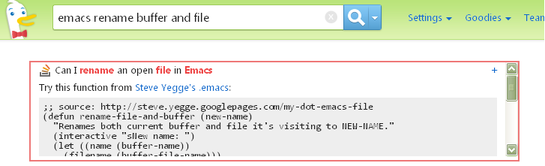
  1. Awesome infobox: This is the tiny box that’s the first thing you see in your search results. It usually links to the wikipedia page if one exists, and provides a one-line summary of your search term. This works surprisingly well sometimes. For instance, I wanted an Emacs function to rename both a buffer and it’s associated file. I badly need this because I write these posts as filename.txt.draft, and then need to rename it to filename.txt so that Blosxom shows it as a post. This is what DDG showed me when I searched for it (above).
  • !Bang: This is a great idea, implemented comprehensively. In short, keywords prefixed by a ! are redirected to a specific site. e.g. !w and !hn send your search queries to wikipedia and hnsearch.com respectively.
  • Privacy: This is so obvious it ought to be the very first point. They’ve created a couple of nice illustrated explanations on how they don’t Bubble or Track their users.
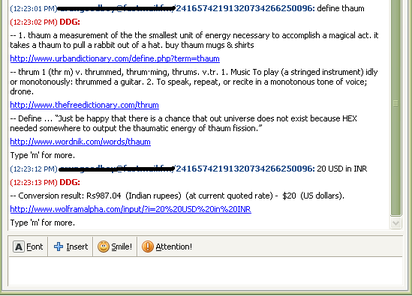
  • They have a chatbot that you can send your search queries to, directly. Add im@ddg.gg and try it out for yourself. Here is what it looks like (pic2 above, until I can figure out Blogger’s attachment quirks)
  • Their ‘I’m Feeling Lucky’ option is called ‘I’m Feeling Ducky’ :)

Learning Javascript with Codecademy

This has been making the rounds lately, and I decided to sign up and give it a whirl — a website called Codecademy that teaches Javascript by throwing you into a terminal so you can practise the commands yourself.

Similar to Khan Academy (and a lot of games), the site implements achievements to reward one’s progress. Mine can be seen in my profile page. It didn’t take too long to finish both the lessons that are currently available. It does look like they plan to implement more exercises soon, so that’s good news.

The hands-on approach works great for programming languages, and it is implemented pretty nicely in this site. I’m looking forward to see new languages in the same format — this is the kind of thing I’d happily pay for.

Do I need another time sink? Yes, yes I do

So I crawled out of the rock I was sleeping in, and discovered that the Internet now does things aside from text and images. Yes! This fabulous new technology, called podcasting, allows some people to record themselves talking, and other people (like me) to subscribe and listen to them.

The software I use is called gPodder, and is a lovely cross-platform (it works on my n900 too!), rich application that supports subscriptions, sync, audio+video, and so on. Their sister site, gPodder.net, allows one to have their subscriptions in a single place that can be sync’d to multiple devices. You can see my subscriptions here.

I’ve already found lovely sites like Escape Pod, which does audiobook readings of scifi short stories; and discovered (via bsdtalk) that OpenBSD has an Emacs-like text editor called mg. If I had a reasonably cheap 3G plan, I’d‘ve loved to be able to stream directly to my phone during my daily commute. For now I suppose I’ll only use it from the desktop.

Text Powered

For about the billionth time, I’ve changed the blog engine that runs this site. This time I’m using blosxom, which is actually pretty cool. Blog posts are just text files, and categories are just folders in which they reside. This works brilliantly, because I can just shoot up Emacs and start typing away.

I finally got around to version-controlling everything as well. This page helped me set up Git, and it is ridiculously easy to use for my simple
needs. I’ve been playing with the CSS layouts and the sidebar contents, and it is a huge relief to know that I can fiddle around to my heart’s content and roll back to a working version if I’ve messed something up.

Blosxom itself is pretty tiny, being a single perl script that reads and formats the posts. Sadly the plugins I was looking for were all leading to dead links. The thoughtful folks at TinyApps.org set up
a mirror that was incredibly useful. I’ve now mirrored the plugins as well, accessible here.

Update: Uh, as you can see, this site now runs on WordPress.